
Ways to CONNECT:
DUO
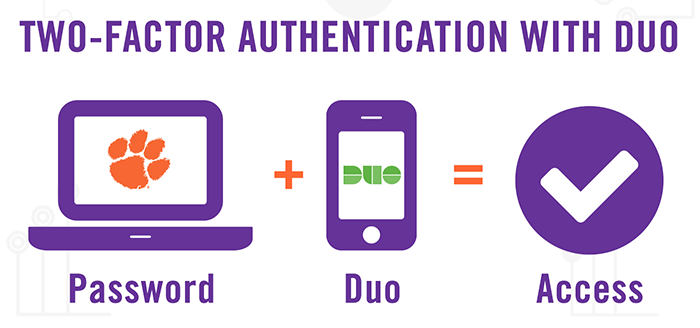
Duo adds a second verification step when you sign in to Clemson systems, including Outlook and Microsoft 365. Depending on your setup, you may verify your identity with a phone, a hardware token, or another supported method. CCIT runs Duo. Enrolling, replacing a phone, and getting a hardware token are all self-service through the
Device Management Portal.
Helpful links
Need Help?
EDUROAM
Clemson password
VPN (Virtual Private Network)
Some Clemson systems answer only from the campus network. Off campus — at home, travelling, on hotel Wi-Fi — connect to CUVPN first. It's CCIT's VPN, using the Cisco Secure Client and Duo.
The Cisco Secure Client is installed on Advancement laptops before they're issued. If it's missing, won't connect, or keeps dropping,
Submit a request to IT Operations.
IT Ops is available to provide in-person support at the following location:
- 220 Madren Center Drive
Clemson, SC 29634
Troubleshooting Basic Problems with WIFI/Connection
When you are away from campus, try these steps to resolve internet connection problems, such as being connected to Wi-Fi without internet access or a router that cannot connect to the internet.
- Restart your computer.
Restarting your computer can resolve many issues. If your computer loses its internet connection, select Start > Power > Restart.
2. Try another website or device.
If you receive an error when visiting Clemson's website, try other websites. You can also check whether another device can connect to the internet. If the problem occurs on only one device, focus on troubleshooting that device.
3. Restart your modem and router.
Unplug your modem and router from their power sources. After a few minutes, plug them back in and check whether the connection is working.
4. Disconnect other devices from the internet.
Try disconnecting other devices in your area, such as:
- Smart TVs
- Roku, Apple TV, and other streaming devices
- Smart home devices, such as Amazon Echo and Google Home
- Phones and tablets: turn off Wi-Fi
- Smart refrigerators: turn off Wi-Fi or make the device forget the network
5. Check for system updates.
Make sure your computer system updates are finished or paused.
6. Check uploads, downloads, and syncing.
Make sure file uploads and downloads are complete or paused. Check that OneDrive, iCloud, and other cloud services have finished syncing files, or pause syncing.
7. Scan for viruses and malware.
Malware or a virus can cause your computer to behave abnormally and may affect your internet connection. Use your antivirus software to run a scan.
8. Reset your router.
If you still cannot connect to the internet, you can reset your router.
Soft reset: Unplug and reconnect the power connector on the front or side of the router.
Hard reset: A hard reset restores the network to its factory settings, including the network name and password. Press and hold the Reset button on the back of the modem or router for more than 30 seconds. The button is normally recessed; you can use a pen or similar tool to press it.
9. Move closer to the router.
The distance between your computer and the wireless access point can affect your Wi-Fi connection. Move closer to the router and try connecting again.
10. Contact your internet service provider.
If you still cannot connect or your internet speed is slow, contact your internet service provider for help.